Swedish Parking Sign "Avgift" with Time Range: Meaning, Examples, and How to Park
This post starts our parking-sign series: each guide focuses on one sign family, explains how to read it quickly, and shows real examples from Swedish streets.
 Parking Sign Master
— turns sign photos into clear parking rules
Parking Sign Master
— turns sign photos into clear parking rules
Quick Answer
✅ Can I park here?
Usually yes. The blue P means parking is allowed, but follow the extra plates below it.
💳 When must I pay?
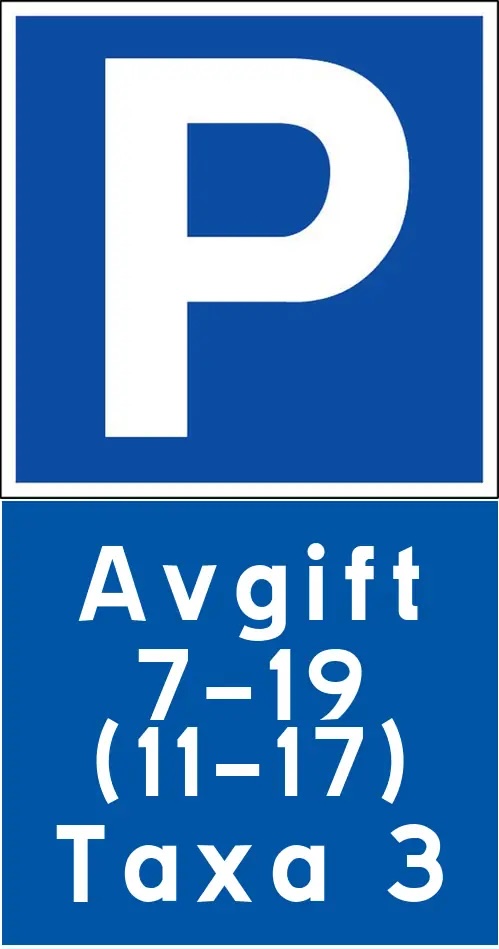
During the shown hours, for example 7-19 on weekdays and (11-17) on Saturdays.
🆓 Outside the time range?
Usually free, unless another plate says otherwise.
How to Read This Sign Family
Golden rule: read from top to bottom. Every lower plate narrows or adds conditions.
Plate 1: Blue P symbol
This gives base permission to park.
Plate 2: Avgift + times + zone
Avgift means paid parking. Important: if Avgift and a time range are on the same plate, this is a combined condition, so the fee applies only within that shown time range. Taxa or zone text defines price level or area code.
Plate 3+: constraints
Examples: Markerade platser (marked spaces only), day-specific no parking, loading windows, resident permit notes.
Before leaving your car
Check if another plate overrides your assumption for specific days, times, or vehicle type.
| Text on sign | Typical meaning |
|---|---|
| Avgift | Fee required during listed hours |
| 7-19 | Weekdays (Mon-Fri), except public holidays and the day before public holidays |
| (11-17) | Saturday or weekdays before public holidays (parentheses) |
| 7-19 (red text) | Sundays or public holidays |
| Taxa 1/2/3 | Rate tier used by municipality |
Real Street Examples
Each example shows the original street photo with a detailed interpretation.
📍 Example 1: Classic Paid Parking
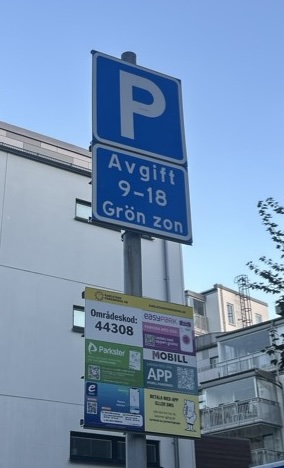
Interpretation: Paid parking in the Green Zone (Grön zon, usually a tariff zone). From 09:00 to 18:00 on weekdays (excluding Saturdays, Sundays, public holidays, and weekdays before public holidays), you must pay to park here. Parking is free outside this time range. The plate below indicates the mobile payment apps drivers can use. In the app, select the områdeskod (area code) 44308.
📍 Example 2: Paid Parking + Marked Spaces + Thursday Restriction
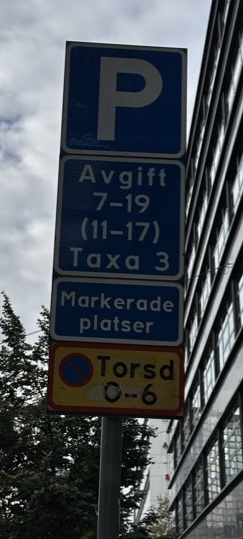
Interpretation: A paid parking rule applies during the listed hours. On normal weekdays (Monday-Friday, excluding public holidays and the weekday before a public holiday), you must pay between 07:00 and 19:00. On Saturdays, and on weekdays that are the day before a public holiday, the paid hours are 11:00-17:00. The tariff is Taxa 3. You may only park in marked parking spaces; parking outside marked bays is not allowed. The no-parking rule applies on Thursday from 00:00 to 06:00 (this also applies on public holidays). Outside the time ranges above, parking is free.
20-Second Checklist Before You Park
- Find the topmost blue P or prohibition symbol.
- Read each plate below in order.
- Map plain times to weekdays, parentheses to Saturday.
- Check for a final exception plate (day-specific restriction, loading window, marked spaces).
- Use zone code/taxa details in your parking app before you leave.
Frequently Asked Questions
What does "Avgift" mean on Swedish parking signs?
It means you must pay a fee to park during the stated paid hours.
What does 7-19 mean?
In this sign family, it usually means the weekday paid window (Mon-Fri), except public holidays and the day before public holidays.
What does 7-19 in red text mean?
In this sign pattern, red-text time ranges typically apply on Sundays and public holidays.
What do parentheses like (11-17) mean?
Parentheses usually indicate Saturday hours or weekdays before public holidays.
What is Taxa 3?
Taxa is the municipal rate tier used to calculate parking fees.
Check Signs Instantly with Parking Sign Master
Take a photo, get plain-language parking rules, and avoid missing hidden restrictions.
- Photo-based interpretation for stacked sign plates
- Clear parking answer: can park, when to pay, and key exceptions
- Built for real Swedish street signs
Disclaimer: This guide is educational and intended to help drivers read signs faster. Always follow the exact sign at your parking location and local municipality rules.